SuzaniUzbekistan
On Lavky since 2022 | 0 Sales |

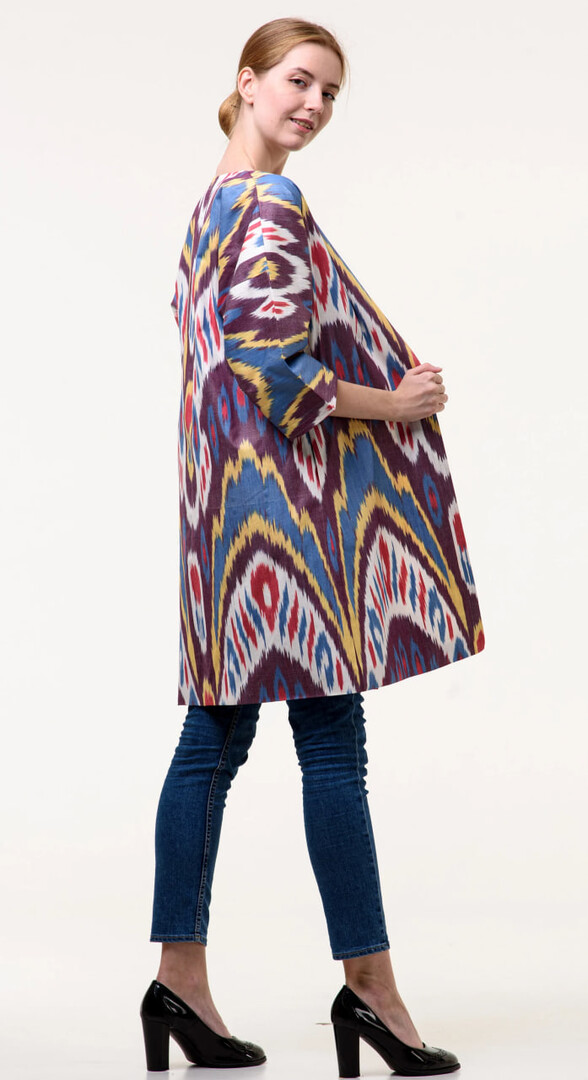
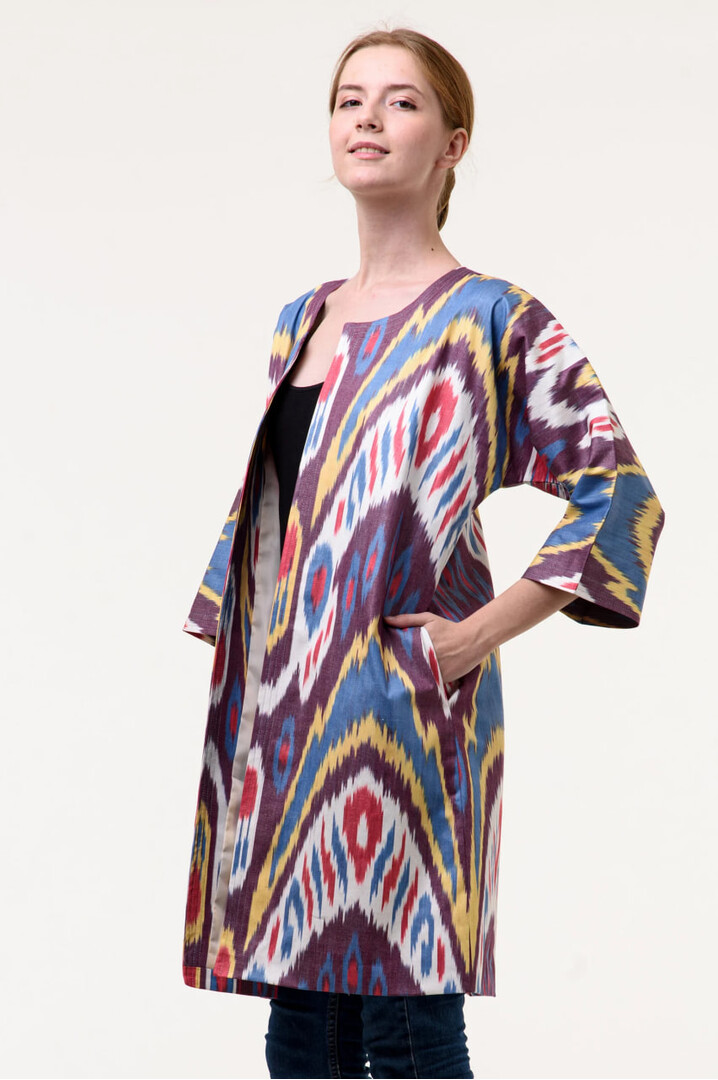
Handwoven Uzbek Ikat Chapan ,coat ,robe,kaftan ,jacket. Hand-dyed, hand loomed natural cotton/silk organic ikat from Uzbekistan

$55.00
New without tag
+

Shipping information

Economy shipping ( $12.00)
Uzbekistan

Description

Handwoven Cotton/silk Ikat Chapan
ONE SIZE (S/M)
ONE SIZE (L/XL)
ONE SIZE (XL/XXL)
Length 90 cm
With pockets
Limited production

Chapan 30% silk,70%cotton made from handwoven ikat which are unique (the technology of ikat manufacturing is quite complicated and includes 37 steps) .

Ikat is a method of fabric making where the pattern is created prior to weaving through the process of resist-dye of the yarns. Central Asian ikats are warp dyed which means the warp – the lengthwise yarn – is manipulated to create the pattern. The workshop cultivates their own silk – a technique also originated in East Asia and brought to Central Asia through the Silk Road. Silk processing is tedious but the silk yarns give ikat its highly-valued sheen. Before any weaving takes place, a master weaver decides on a pattern from hundreds he has committed to memory while his helpers bundle the yarns and lay them out on a 2×2 meter frame. He then draws the pattern on the outstretched bundles using a sharpened stick dipped in oil and charcoal, marking where the threads are to be bound. His assistant will wrap the bundles at these specific spots using dye-resistant threads of cotton soaked in wax. The yarn bundles are then transferred to the dye bath in the exact order they are on the frame otherwise the pattern would be broken. In the case of multiple color ikat – after each dye-bath, the bundles are left to dry then re-stretched on the frame for the second round of binding and dyeing. The genius of the master craftsman is in strategizing the steps so that the next dye bath adds onto the previous to either forms a pattern in its own shade or combine with the previously dyed parts to make a new color. With natural dyeing, each color may require a different temperature and condition so this is also something to take into account. From the basis of less than five natural colors, the artisans can create a variety of colors and an unlimited possibility of pattern combination. The points where the yarn bundles are tied to the 2×2 meter frame result in a line repeating every two meters or so in the final woven fabric. This line distinguishes handmade from machine-made ikats and is an inevitable feature of traditional ikat weaving.
This process produces no more than 40 inches of fabric a day.

More from this vendor

1970s Suzani handmade 150*230 cm -cotton foundation -cotton embroideries Condition:excellent. Suzani is a type of embroidered and decorative tribal textile.The birthplace of suzani is in what is now Uzbekistan, the area along the Silk Road . The suzani was an integral part of a woman's artistic expression in Uzbekistan for hundreds of years. Traditionally, as soon as a girl was born her mother would start embroidering the suzani for her. As the daughter grew older, she would join in the process. The suzani would eventually become a part of her dowry and be used to decorate her home. These intricate and lovingly-made textiles can be used in so many ways to add texture, romance, and delight to any room.
$140.00
Handwoven Cotton/silk Ikat Chapan ONE SIZE (S/L) ONE SIZE (L/XL) Length 135 cm With pockets Limited production Chapan 30% silk,70%cotton made from handwoven ikat which are unique (the technology of ikat manufacturing is quite complicated and includes 37 steps) . Ikat is a method of fabric making where the pattern is created prior to weaving through the process of resist-dye of the yarns. Central Asian ikats are warp dyed which means the warp – the lengthwise yarn – is manipulated to create the pattern. The workshop cultivates their own silk – a technique also originated in East Asia and brought to Central Asia through the Silk Road. Silk processing is tedious but the silk yarns give ikat its highly-valued sheen. Before any weaving takes place, a master weaver decides on a pattern from hundreds he has committed to memory while his helpers bundle the yarns and lay them out on a 2×2 meter frame. He then draws the pattern on the outstretched bundles using a sharpened stick dipped in oil and charcoal, marking where the threads are to be bound. His assistant will wrap the bundles at these specific spots using dye-resistant threads of cotton soaked in wax. The yarn bundles are then transferred to the dye bath in the exact order they are on the frame otherwise the pattern would be broken. In the case of multiple color ikat – after each dye-bath, the bundles are left to dry then re-stretched on the frame for the second round of binding and dyeing. The genius of the master craftsman is in strategizing the steps so that the next dye bath adds onto the previous to either forms a pattern in its own shade or combine with the previously dyed parts to make a new color. With natural dyeing, each color may require a different temperature and condition so this is also something to take into account. From the basis of less than five natural colors, the artisans can create a variety of colors and an unlimited possibility of pattern combination. The points where the yarn bundles are tied to the 2×2 meter frame result in a line repeating every two meters or so in the final woven fabric. This line distinguishes handmade from machine-made ikats and is an inevitable feature of traditional ikat weaving. This process produces no more than 40 inches of fabric a day.
$77.00
Handwoven Cotton/silk Ikat Chapan ONE SIZE (S/L) ONE SIZE (L/XL) Length 135 cm With pockets Limited production Chapan 30% silk,70%cotton made from handwoven ikat which are unique (the technology of ikat manufacturing is quite complicated and includes 37 steps) . Ikat is a method of fabric making where the pattern is created prior to weaving through the process of resist-dye of the yarns. Central Asian ikats are warp dyed which means the warp – the lengthwise yarn – is manipulated to create the pattern. The workshop cultivates their own silk – a technique also originated in East Asia and brought to Central Asia through the Silk Road. Silk processing is tedious but the silk yarns give ikat its highly-valued sheen. Before any weaving takes place, a master weaver decides on a pattern from hundreds he has committed to memory while his helpers bundle the yarns and lay them out on a 2×2 meter frame. He then draws the pattern on the outstretched bundles using a sharpened stick dipped in oil and charcoal, marking where the threads are to be bound. His assistant will wrap the bundles at these specific spots using dye-resistant threads of cotton soaked in wax. The yarn bundles are then transferred to the dye bath in the exact order they are on the frame otherwise the pattern would be broken. In the case of multiple color ikat – after each dye-bath, the bundles are left to dry then re-stretched on the frame for the second round of binding and dyeing. The genius of the master craftsman is in strategizing the steps so that the next dye bath adds onto the previous to either forms a pattern in its own shade or combine with the previously dyed parts to make a new color. With natural dyeing, each color may require a different temperature and condition so this is also something to take into account. From the basis of less than five natural colors, the artisans can create a variety of colors and an unlimited possibility of pattern combination. The points where the yarn bundles are tied to the 2×2 meter frame result in a line repeating every two meters or so in the final woven fabric. This line distinguishes handmade from machine-made ikats and is an inevitable feature of traditional ikat weaving. This process produces no more than 40 inches of fabric a day.
$77.00
Please, provide your phone number for shipping purposes. Please specify the size in the comments or messages. Measurements: length-90 cm, chest-108 cm,length sleeve-52 cm,hips-110 cm.(S/L) Measurements: length-90 cm, chest-112 cm,length sleeve-52 cm,hips-114 cm.(L/XL) Chapan 20% silk,80%cotton made from handwoven ikat which are unique (the technology of ikat manufacturing is quite complicated and includes 37 steps) . The technology of ikat manufacturing is quite complicated and includes 37 steps.Ikat is a method of fabric making where the pattern is created prior to weaving through the process of resist-dye of the yarns. Central Asian ikats are warp dyed which means the warp – the lengthwise yarn – is manipulated to create the pattern. The workshop cultivates their own silk – a technique also originated in East Asia and brought to Central Asia through the Silk Road. Silk processing is tedious but the silk yarns give ikat its highly-valued sheen. Before any weaving takes place, a master weaver decides on a pattern from hundreds he has committed to memory while his helpers bundle the yarns and lay them out on a 2×2 meter frame. He then draws the pattern on the outstretched bundles using a sharpened stick dipped in oil and charcoal, marking where the threads are to be bound. His assistant will wrap the bundles at these specific spots using dye-resistant threads of cotton soaked in wax. The yarn bundles are then transferred to the dye bath in the exact order they are on the frame otherwise the pattern would be broken. In the case of multiple color ikat – after each dye-bath, the bundles are left to dry then re-stretched on the frame for the second round of binding and dyeing. The genius of the master craftsman is in strategizing the steps so that the next dye bath adds onto the previous to either forms a pattern in its own shade or combine with the previously dyed parts to make a new color. With natural dyeing, each color may require a different temperature and condition so this is also something to take into account. From the basis of less than five natural colors, the artisans can create a variety of colors and an unlimited possibility of pattern combination. The points where the yarn bundles are tied to the 2×2 meter frame result in a line repeating every two meters or so in the final woven fabric. This line distinguishes handmade from machine-made ikats and is an inevitable feature of traditional ikat weaving. This process produces no more than 40 inches of fabric a day. Dry cleaning recommended.
$77.00
Handwoven Cotton/silk Ikat Chapan ONE SIZE (M/L) ONE SIZE (L/XL) ONE SIZE (XL/XXL) Length 135 cm With  pockets Limited production                                                                                                                                      Chapan 30% silk,70%cotton made from handwoven ikat which are unique (the technology of ikat manufacturing is quite complicated and includes 37 steps) . Ikat is a method of fabric making where the pattern is created prior to weaving through the process of resist-dye of the yarns. Central Asian ikats are warp dyed which means the warp – the lengthwise yarn – is manipulated to create the pattern. The workshop cultivates their own silk – a technique also originated in East Asia and brought to Central Asia through the Silk Road. Silk processing is tedious but the silk yarns give ikat its highly-valued sheen. Before any weaving takes place, a master weaver decides on a pattern from hundreds he has committed to memory while his helpers bundle the yarns and lay them out on a 2×2 meter frame. He then draws the pattern on the outstretched bundles using a sharpened stick dipped in oil and charcoal, marking where the threads are to be bound. His assistant will wrap the bundles at these specific spots using dye-resistant threads of cotton soaked in wax. The yarn bundles are then transferred to the dye bath in the exact order they are on the frame otherwise the pattern would be broken. In the case of multiple color ikat – after each dye-bath, the bundles are left to dry then re-stretched on the frame for the second round of binding and dyeing. The genius of the master craftsman is in strategizing the steps so that the next dye bath adds onto the previous to either forms a pattern in its own shade or combine with the previously dyed parts to make a new color. With natural dyeing, each color may require a different temperature and condition so this is also something to take into account. From the basis of less than five natural colors, the artisans can create a variety of colors and an unlimited possibility of pattern combination. The points where the yarn bundles are tied to the 2×2 meter frame result in a line repeating every two meters or so in the final woven fabric. This line distinguishes handmade from machine-made ikats and is an inevitable feature of traditional ikat weaving. This process produces no more than 40 inches of fabric a day.
$95.00
Handwoven Cotton/silk Ikat Chapan ONE SIZE (M/L) Length 135 cm With pockets Limited production Chapan 30% silk,70%cotton made from handwoven ikat which are unique (the technology of ikat manufacturing is quite complicated and includes 37 steps) . Ikat is a method of fabric making where the pattern is created prior to weaving through the process of resist-dye of the yarns. Central Asian ikats are warp dyed which means the warp – the lengthwise yarn – is manipulated to create the pattern. The workshop cultivates their own silk – a technique also originated in East Asia and brought to Central Asia through the Silk Road. Silk processing is tedious but the silk yarns give ikat its highly-valued sheen. Before any weaving takes place, a master weaver decides on a pattern from hundreds he has committed to memory while his helpers bundle the yarns and lay them out on a 2×2 meter frame. He then draws the pattern on the outstretched bundles using a sharpened stick dipped in oil and charcoal, marking where the threads are to be bound. His assistant will wrap the bundles at these specific spots using dye-resistant threads of cotton soaked in wax. The yarn bundles are then transferred to the dye bath in the exact order they are on the frame otherwise the pattern would be broken. In the case of multiple color ikat – after each dye-bath, the bundles are left to dry then re-stretched on the frame for the second round of binding and dyeing. The genius of the master craftsman is in strategizing the steps so that the next dye bath adds onto the previous to either forms a pattern in its own shade or combine with the previously dyed parts to make a new color. With natural dyeing, each color may require a different temperature and condition so this is also something to take into account. From the basis of less than five natural colors, the artisans can create a variety of colors and an unlimited possibility of pattern combination. The points where the yarn bundles are tied to the 2×2 meter frame result in a line repeating every two meters or so in the final woven fabric. This line distinguishes handmade from machine-made ikats and is an inevitable feature of traditional ikat weaving. This process produces no more than 40 inches of fabric a day.
$93.00

Reviews

No posts found

Shipping and Policies

Payment

This store is integrated with the Western Bid™ e-commerce platform, and Western Bid, Inc. is the Merchant of Record for all purchases made in this store. Therefore, you will see "WESTERN BID" listed as the payee on your PayPal account and credit card statement.

I accept PayPal or Credit Cards only.
• Your items will be made and shipped only after the payment is cleared.
• If you don't have Paypal account and would like to pay with your Credit Card, check this step-by-step tutorial on PayPal:
https://www.paypal.com/webapps/mpp/pay-online

Your order will be shipped only after the payment is cleared. This means if you pay via Paypal e-checks there could be delay in 3-5 business days. You can check the status of your payment in your Paypal account or in the correspond invoice here on Lavky.

Shipping

All the items in the order will be securely packed and shipped within 1-3 working days of payment.
Some items may take longer. If the processing time is more than 7 days, it is clearly stated in the product description.

Delivery Address:

• Please make sure your shipping address is correct at the checkout. 

We will ship your order to the address specified on Lavky.com checkout, and not to the address specified on Paypal.

Terms of Delivery

We always ship parcels with a tracking number. We will update you on the tracking number once your order has been prepared and shipped.

Usually delivery takes between one a half and four weeks.

Please note that delivery times may vary depending on your location and customs clearance, so we cannot guarantee the exact time of arrival.

Here are the approximate delivery times:

- USA: 1.5 - 2.5 weeks

- Canada: 2-3 weeks

- Europe: 1-2 weeks

- Australia: 2-3 weeks (sometimes longer, depending on Australian customs)

- The rest of the world: 2-3 weeks

Delivery method

We ship all the parcels from Ukraine (from our logistics centers in Kyiv and Chernivtsi) via international services (FedEx, UPS) in two stages. 

First a parcel is sent by express delivery service to Europe, and then, it is shipped by air mail to the United States, Canada or Europe. 

You can see the movement of the parcel by a tracking number only in the second stage - 4-6 days after sending your order from our center. We estimate the delivery time to 12-18 days.

Express delivery is available only on individual request. Please contact us if you need Express delivery before placing an order so we can update shipping options.

Customs duties and taxes

Customers are responsible for any fees, taxes and duties related to delivery and ordering products to their country of destination.

Packaging

Your order will arrive in a safe cardboard box, with due packaging and protection from damage.

Refunds and Exchanges

I want my clients to be happy, so report me if you have any problems.

If you are not satisfied with your items / service for any reason, please contact me with the problem before leaving a feedback.